
Scout Dogs: The Teams That Walked Point in the Jungle
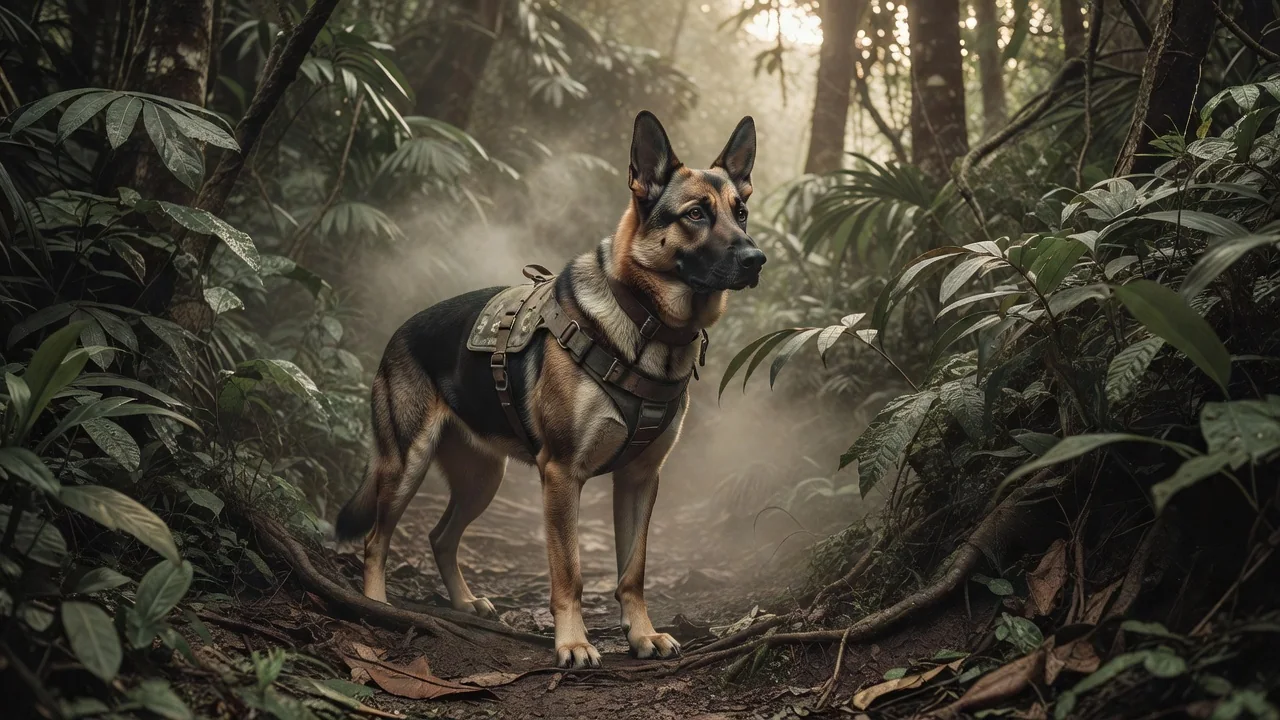
In the dense, humid jungles of Vietnam, the most dangerous position on any patrol was “point”—the lead man who first encountered the enemy. That role often fell to a four-legged soldier and his human partner. Army scout dog teams, usually a German Shepherd paired with a dedicated handler, moved silently ahead of infantry platoons, turning instinct and training into an early-warning system that saved countless lives.
Handlers learned to read their dogs the way sailors read the sky. A slight cock of the ears, a sudden tension in the shoulders, a hesitation in stride—these were the silent signals of danger. The dog might freeze at the scent of an ambush, detect a tripwire stretched across a trail, or alert to the faint metallic smell of a freshly buried mine. In an environment where visibility was measured in feet, the dog’s nose and ears became the patrol’s most valuable sensors.
The Platoons That Led the Way
Four dedicated Infantry Scout Dog Platoons—the 42nd, 44th, 48th, and 58th—were attached to major combat divisions including the 25th Infantry Division and the 1st Cavalry Division. Each platoon consisted of about thirty dog teams, supported by veterinary staff and trainers. Units quickly learned which handlers and dogs performed best under fire. Requests for specific teams by name became common; commanders knew that a reliable dog could mean the difference between walking into a kill zone and spotting the enemy first.
Training and the Bond Between Man and Dog
Handlers and dogs trained together for months at Lackland Air Force Base before deployment. The bond was absolute. In the field the handler depended entirely on interpreting his dog’s body language. A loose leash meant confidence; a stiff tail and raised hackles meant threat. Many handlers slept beside their dogs, shared their rations, and refused to rotate home without them. When a dog was killed in action, the handler often carried the loss like that of a brother.
- Dogs detected hidden bunkers by scent long before visual reconnaissance
- Handlers walked without rifles so they could focus solely on the leash and dog
- Most teams operated at night when enemy movement increased
- Handlers used hand signals and soft voice commands to keep dogs silent
The work was exhausting and heartbreaking. Dogs suffered from heat exhaustion, jungle rot, and enemy fire. Handlers learned to trust an animal’s instincts over their own fear. In after-action reports, infantry officers repeatedly credited scout dogs with preventing ambushes that would have cost entire platoons.
| Platoon | Primary Division | Notable Achievement |
|---|---|---|
| 42nd ISDP | 25th Infantry | Over 200 ambushes detected in 1967-68 |
| 44th ISDP | 1st Cavalry | High success rate in night patrols |
| 48th ISDP | 4th Infantry | Specialized in tunnel detection |
Today these dogs are remembered not as equipment but as frontline comrades. Their handlers still speak of them with quiet pride, recalling how a single German Shepherd walking point could turn the jungle from a place of terror into a readable map of threats and safe passage. The silent language between man and dog remains one of the most effective reconnaissance tools the Army ever fielded.